Reminiscences
A shared trait I've noticed among disciplinary experts is that they all tend to have a raison d'etre for their chosen profession. Obviously this isn't unique: careerists and hobbyists across the board would describe a sense of ikigai underpinning what they do, but especially when it comes to niche occupations – where pay rarely stands out as the central motivator – professionals are bonded to their work more out of passion than anything else. And it depends on who you ask – not everyone examines so closely what brought them into the fold – but of the people I've talked to, most of them have a flash point story: a moment of realization where it became clear that this is what they want to do in life.
As of late 2025, I've been a dedicated botanist for 10 years. Of course, "dedicated" in this case basically rounds out to "passionate amateur" – I have no higher degree, and in the time I've been doing this I've received not one cent for my input. (This is, for the record, not an unusual thing in the natural sciences – especially in America.) The caliber of expertise I described in the prior paragraph doesn't really apply to me, but I've given much of myself over to plant science in that time, and as the years have gone on I find myself only more committed to botany. Exempting death or TBI I can't picture a life ten years out where I'm not still doing this, so I thought I'd take some time – for myself if not anyone else – to submit my own awakening story.
Even during childhood the conditions were right for me to be a plant nerd: born to two analytical chemists (a talent that I can assure you wasn't passed down), I was brought up in a household of both compulsory inquiry and habitual agrarianism. My folks have always been avid gardeners, and I became the reliable second party for springtime seed-starting initiatives and home science experiments in water propagation. During my teenage years – I guess for something to do – I would end up water-propping things on my own time (mint was always a personal favorite, they tend to be enthusiastic root-setters).
In many ways, the environment was also right: Colorado has a complicated relationship with its native biomes (what state doesn't?) but the Front Range boasts a wide array of outdoor opportunities, and so I was brought up with ample exposure to my local climates. As a family we would take yearly camping trips out into the Rocky Mountains, and on one of these occasions my dad bought a couple foraging guidebooks, which in time would supply my pre-internet fascination with unorthodox produce.
Given all this you'd think plants would be a likely candidate for hyperfixation, but this wasn't the case – at least not right away. I had the occasional brush with horticulture here and there (for a couple years in high school I kept the saddest, most etiolated cactus words can describe), but things wouldn't fully crystallize until I was in college.
Fall 2015 wasn't a great time: after a catastrophic freshman year I had decided (or rather, was given the choice) to transfer schools – favoring a more economical, commuter-friendly option I could attend while staying with my parents. I inadvertently submitted the paperwork too late, however, and thus ended up taking an unplanned gap semester. I spent this season reclusive, jobless, isolated from my friends, and nursing the early years of a Major Depressive Disorder diagnosis (which I neglected to treat for a variety of indefensible reasons). It was my first real crisis as an adult: the least severe in retrospect, but uniquely harsh in its novelty.
What kept me tethered during all this was a nascent interest in botany: tropical botany, to be exact – culinary tropical botany. Maybe it began when I was a teenager, playing Animal Crossing: New Leaf and – for the first time in my Euroamerican life – seeing digitally-rendered lychees and durians. It could've been all the foraging videos I binged in my freshman year of college, or the horticulturally-rich campus that had inspired that habit (the campus in question had a cherry plum tree on my way to class, and for two weeks in September its fruit comprised 70% of my diet). Perhaps it had something to do with the online rabbit holes: the reams of Wikipedia articles, YouTube videos and old forum threads left available for my perusal. It takes an ignition source to start a fire, and fuel to keep it maintained.
But tropical botany, of all things? For this, my explanation's less elaborate: when you live your whole life on the high plains you begin to itch for an environment that isn't just unfamiliar, but diametrically opposed to your present surroundings. Nowadays I'm quite devoted to Colorado flora, but this came with years of learning and observation, and wasn't so readily available in the moment. I didn't go out looking for plants during this time, but they seemed to find me just as well.
I was first introduced to dragon fruit not at a garden center or grocery store, but at an estate sale: it was an old mid-mod house in the Denver suburbs, whose owners must have been downsizing because the property was still well-maintained. Despite the markup none of their items fell in my price range (I had no job, remember), but I was more there to peruse and – inkeeping with my generation – fantasize about homeownership. In the east-facing kitchen window they had a little cluster of cacti: deep-green forest cacti, whose triangular arms spilled out from their confines onto the linoleum countertop. It didn't seem to be for sale – no price tag to speak of – but the owners were long gone and the liquidators would likely end up throwing it away, what harm was there in taking a pad or two? This was how I justified it to myself – I'm not proud of it, but I'd do it again in a heartbeat.
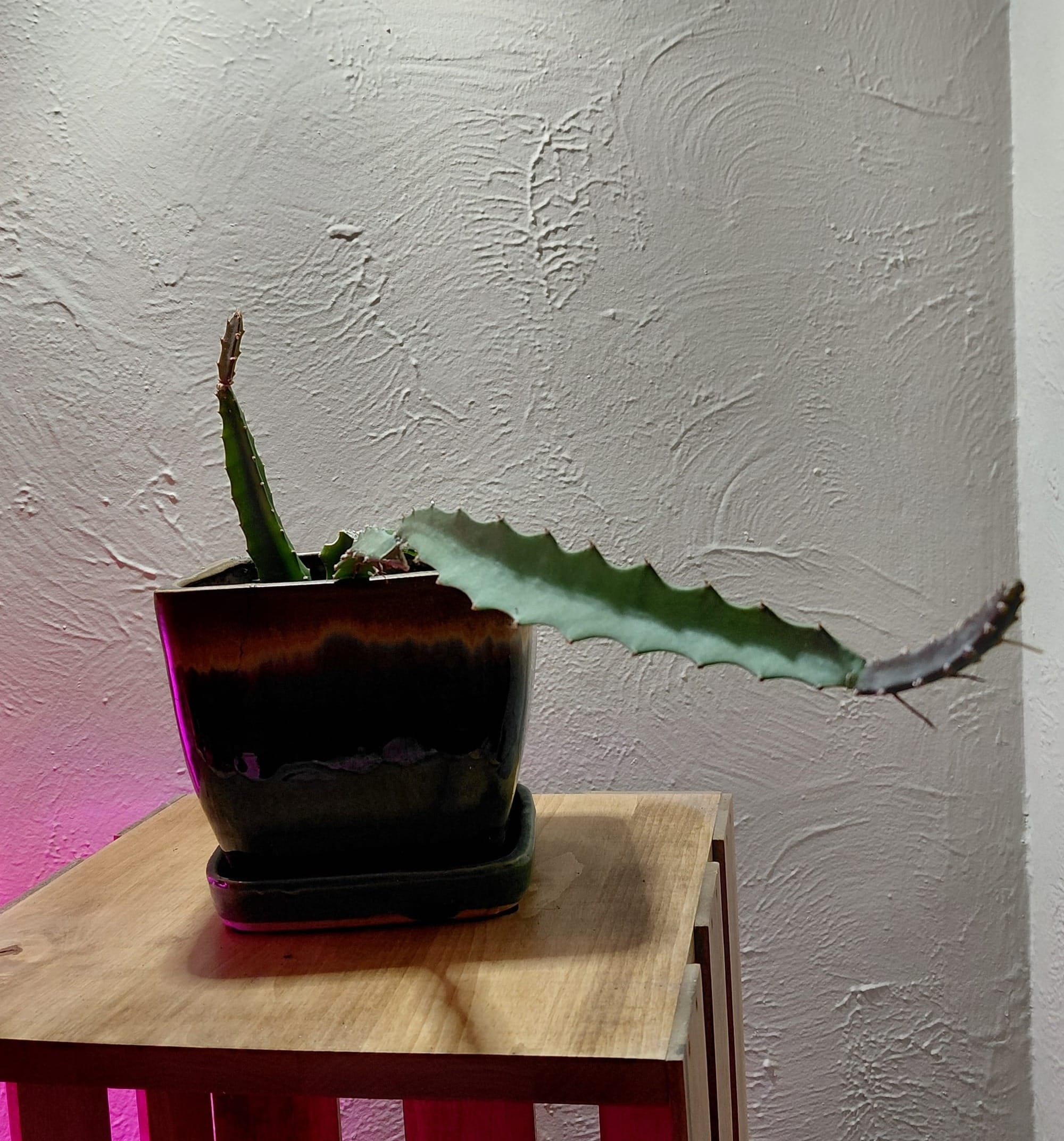
And to be honest, I don't really know for sure whether Cecelia (one of the only plants I'd ever name) was actually a dragon fruit: she never flowered in my care, and "three-ribbed cactus" is about as narrow of an identifier as "white-flowered aster" or "little brown bird." Her precise identity (or lack thereof) was a real stressor for me as a novice: I split hairs trying to discern whether or not this two-inch long pad was actually from a dragon fruit, or if it had instead been from an Epiphyllum or Acanthocereus, or worst of all a Stapelia (they each feel equally plausible when you've only seen them online). This was because I had aspirations for Cecelia: if she really was a Hylocereus (technically now a Selenicereus – cactus taxonomy sucks), I wanted to see if I could potentially grow her to fruiting size.
I wasn't yet so familiarized to know that this was impossible: that dragon fruit only ever yield in continuous tropical warmth, with a lot of room to grow, and with a near-constant nutritional inlet. In Colorado you'd do just as well trying to house a captive tiger; not that it couldn't be done, but it would take resources well beyond my present capacity. In my time with her she grew a great deal but never flowered, and in retrospect I think this effectively proves that she was the genuine article.
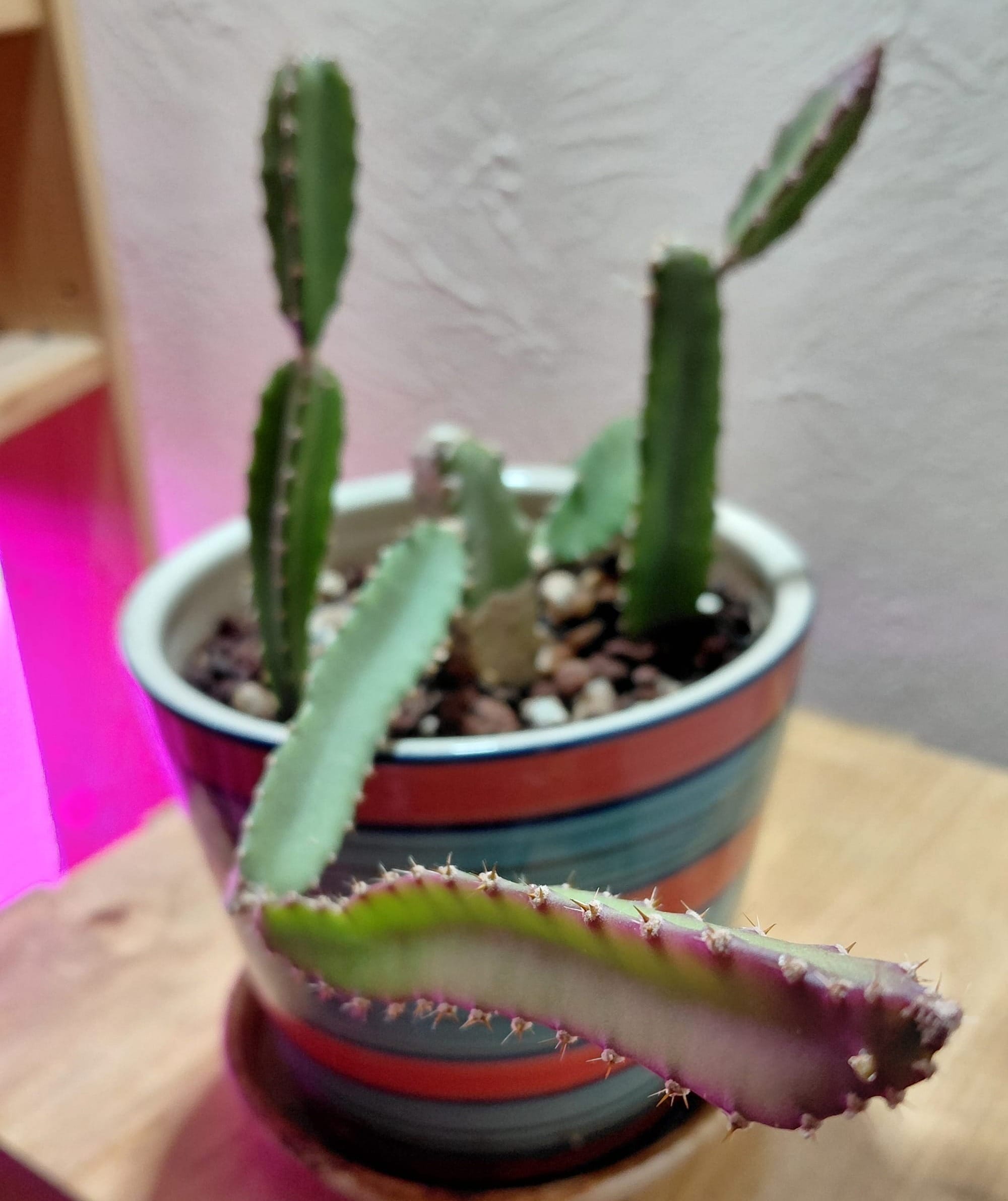
Suffice it to say that, when I returned to school in 2016, the interest I'd developed in plants really took the reins: I pursued so much botanical coursework that I ended up minoring (nearly double-majoring) in biology, and while today my work lies in neither of my chosen academic vocations, I owe much of my current trajectory to the decisions I made in that empty semester – where my only company was a denuded cactus branch.
Unfortunately, Cecelia Prime is no longer in my custody. A few years after acquiring her I hit my limit in terms of space and – having two other positively identified dragon fruits in my possession – I made the mercenary decision to gift her to a friend. I scrounged my digital storage for pictures of her (I took quite a few), but this had all happened multiple phones ago, and I don't appear to have backed any of that old storage up. But rest assured, Cecelia Prime is survived by her two successors: Cecelia Mark II (a seed-grown Selenicereus megalanthus), and Cecelia Mark III (a pad-grown S. stenopterus). I've had a lot of plants lapse in and out of my collection, but I'd be remiss not to keep a dragon fruit out of deference for where it all started.