Pasqueflowers

Despite it being the worst of all these Colorado winters, the pasqueflowers in their inimitable patience seemed neither to notice nor care.
If you live in the temperate northern hemisphere, you're likely familiar with the genus Pulsatilla: P. patens (originally endemic to a wide swath of Eurasia) has since been naturalized to much of the temperate world as a springtime garden ornamental – none dissimilar to tulips, crocuses and hyacinths. It stands as our horticultural representative for the genus as a whole, which at the time of writing stands at a modest 40 species distributed gregariously over the northern hemisphere.
At the time of writing this I'm only familiar with one endemic American Pulsatilla (though I feel like there have to be more than just that), and that is the Prairie pasqueflower: P. nuttalliana. As the common name betrays, this flower specializes in the American prairie: with a native range extending from Alaska and the Yukon, across the Canadian Plains, down through the American high plains into Colorado and New Mexico. They may not be capital-e Extremophiles, but they've acclimated to some notoriously temperamental locales.

Part of their success is owed to their phenology: Pasqueflowers are perennial spring ephemerals, meaning they're long-lived organisms adapted to flower and fruit over the brief interstices between winter and summer (spring might be more glorious in other places, but on the steppe it can sometimes last only a few weeks, with frequent interruptions by recurrent winter storms). Flowers often emerge before the leaves, and once pollinated develop into a cluster of filamentous achenes, which are then scattered by the wind.
There's a particular advantage in being a spring ephemeral, especially in challenging climates such as the prairie: in emerging right after the thaw you avail yourself to an abundance of water, and are able to take exploit the lower competition when it comes to native pollinators.
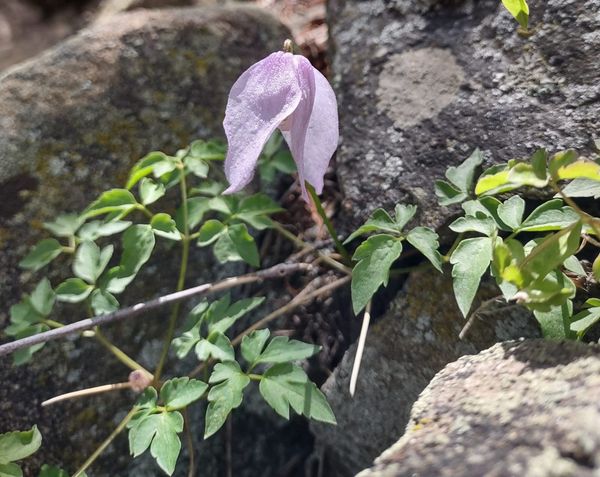
One of my favorite aspects of Pulsatillas – and of P. nuttalliana in particular – is how ethereal they appear at a distance: flowers are pale pink, emerging from the brittle earth on thin stalks, veiled by a trichomatous halo – an ermine pelt buffering them from the brusque late-winter air. Seeing them in their endemic context sends a clear message: you made it. Winter is over.
But what if – in such a year as 2026 – there was no winter to speak of? A year where nary a snowflake graced the front range, and temperatures fell below 50 Fahrenheit once a month at best? Apparently for the Pasqueflowers, this means they emerge in full force: not in a series of staggered blooms, but in one massive thrust. I'm not in the position to tell you if this is a good or bad thing: if a large bloom correlates to a successful promulgation, or if next year they will pay the deferred price of this brutally early season. Longitudinal questions like that are outside my pay grade. What I can tell you is that it was heartening, to walk in these barren hills and to see something undeterred by the new extreme.